Triagewall
Local-LLM Suricata alert triage for homelabs. Reduce alert noise without sending data to the cloud.
If you run Suricata on OPNsense or pfSense, you know the problem. Thousands of alerts a day, mostly noise. The signal is in there, but you're not going to find it at 11 PM.
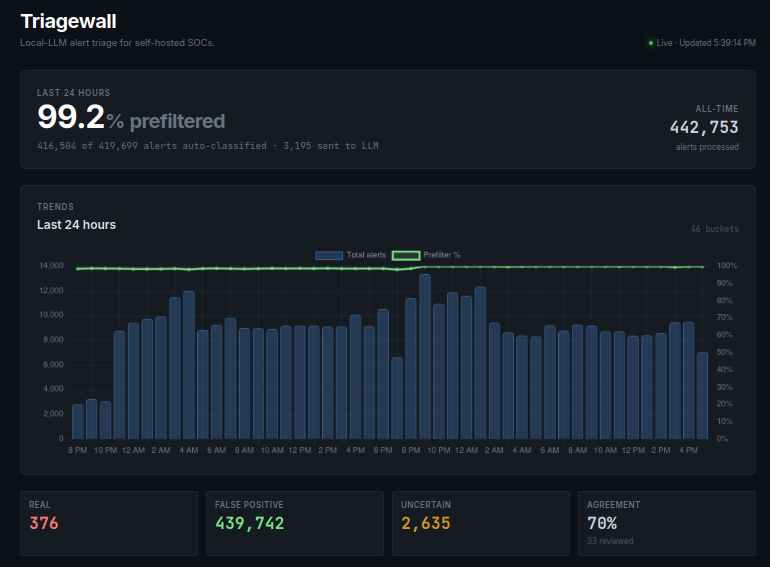
Triagewall pre-filters known-benign signatures with a tunable JSON config (microsecond lookups, zero LLM cost), then sends the residual long tail to a local Ollama model for classification. On a typical homelab, the prefilter handles 99%+ of alerts after a day of tuning. The LLM sees only the genuinely interesting traffic.
v0.2 hardens the LLM stage against prompt injection: a canary token detects in-band tampering, strict response-schema validation rejects out-of-spec output, and 16 attacker-controlled alert fields are base64-encapsulated with explicit boundary markers so injected text can't escape the data envelope.
Free and AGPL-3.0. Runs on your hardware. No telemetry. Default model is Foundation-Sec-8B-Instruct (Cisco's security-domain LLM), running on any GPU with 8GB+ VRAM.
Install
git clone https://github.com/aaronphifer/triagewall
cd triagewall
docker compose up -d
Dashboard at http://localhost:8084.
Demo mode included — no Suricata required to evaluate.
Measured in production